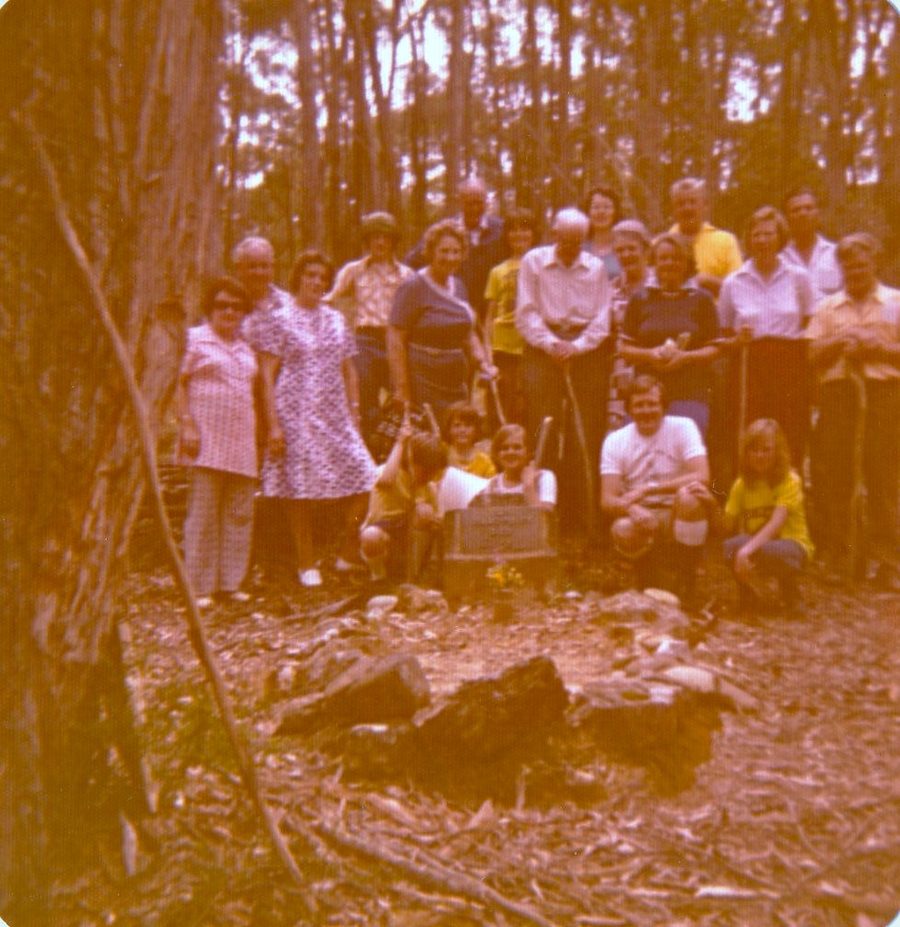
Isaac Povey
Isac Povey Booklet
Take the full story home with the illustrated A5 booklet by Margot Hitchcock.
Who Was Isaac Povey?
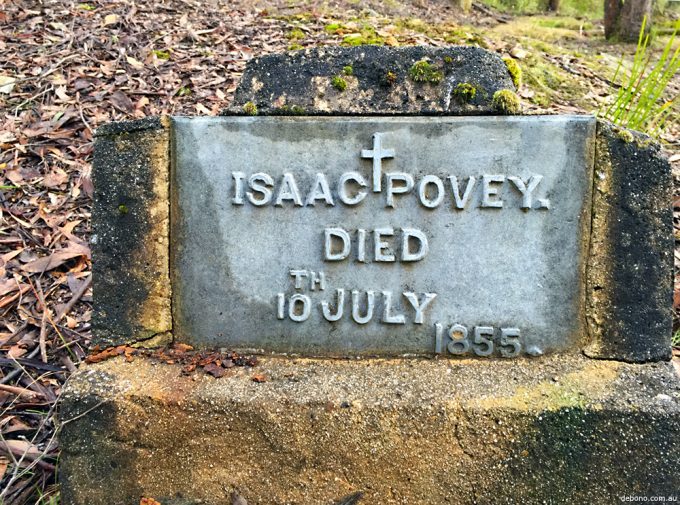
Hidden away at the back of Blackwood atop “Dead Man’s Hill” lies a small headstone which bears the inscription, “Isaac Povey, died July 10th, 1855.” Who is Isaac Povey and what part did he play in the town of Blackwood?
Research by Margot Hitchcock, Historian for the Blackwood and District Historical Society.
Isaac Povey is recorded as being born in Birmingham, and was christened on the 21st August 1834 at St. Phillips, Birmingham, Warwickshire in England. His parents were recorded as John and Mary Povey and he had two brothers, Charles Povey and Joseph Povey, and a sister Mary Povey.
He was 21 years of age when he came out to Australia landing in New South Wales in 1854, with his mate John Edward Hill from West Bromwich, Birmingham, England. He came out hoping to make his fortune and then return to his sweetheart, Mary, within three years.
Povey and Hill first went to Sydney where they worked on building the Sydney Mint in their trade as bricklayers. Upon researching and learning of suitable gold bearing locations they decided to try their luck. Later they arrived in Melbourne and made their way to the Mount Blackwood ranges.
Within a year, Isaac Povey caught a chill and died. As there was no cemetery at that time in Blackwood, John Edward Hill buried his friend in a coffin made of sheets of bark, on the summit of the hill now known as Deadman’s Hill, Simmons Reef, and marked the grave with stones and a wooden tablet.
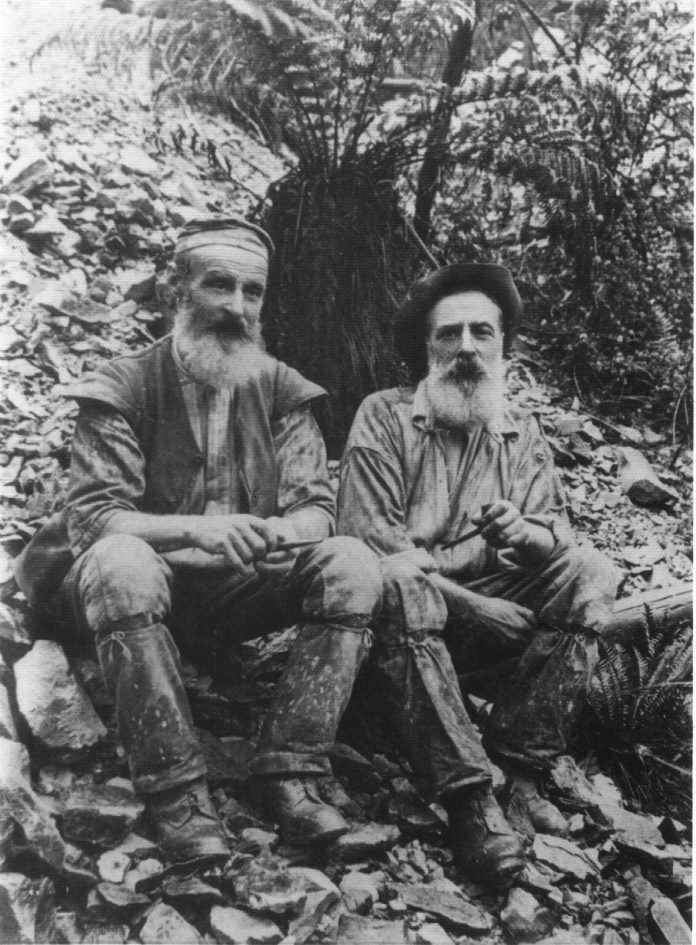
John Hill, twenty-three years later
So Mary waited, but Isaac never returned.
The Grave Rediscovered
Many years later, the lone grave was visited by a Mr. Tom Johnson, then the proprietor of a foundry in the Melbourne suburb of Brunswick. Some years later, Mr Johnson visited Birmingham on matters connected with his foundry business, and walking along a street, he noticed above a business premises the name of Povey, which struck a chord in his memory. On impulse, Mr. Johnson went inside, and on meeting the principals of the firm, asked if any relative of theirs had gone to the Australian goldfields. He learned that there was indeed a relative called Isaac Povey who had gone to Australia, and the family believed, although without certainty, that he had died soon after arriving in Australia. To their very great interest and gratitude, Mr. Johnson told them of the grave of Isaac Povey on the hill above the Lerderderg River in Blackwood.
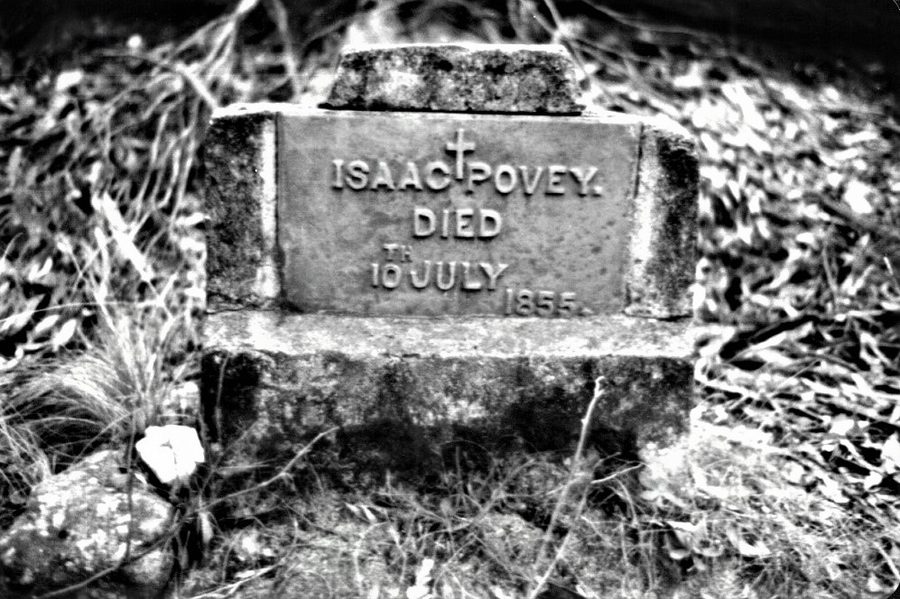
Several years later, around 1926, a bush fire swept through the hills, and the wooden tablet on the grave of Isaac Povey was destroyed. Mr. Johnson having heard of the fire, made another visit to Blackwood and revisited the grave. After talks with the local people he offered to have a bronze tablet cast in his foundry. This he did and the local residents transported it to Deadman’s Hill and erected the headstone on the grave with the inscription reading “Isaac Povey, died July 10th 1855.”
Information on Tom Johnson comes from The Australia Post Office magazine August-September issue 1960, page 7, written by the late Joseph Shaw, courtesy of the late Grace Rayner. Joseph Shaw and his family were connected to Shaw’s Lake, Blackwood, and old Joseph Shaw lived in a log cabin in Blackwood in Whalebone Road.
John (Edward) Hill: The Research
Becoming so engrossed with this research, Margot wrote away to England and joined the Birmingham and Midland Society for Genealogy and Heraldry. She wrote an article requesting help with information regarding John Edward Hill and Isaac Povey, who both came from West Bromwich, Staffordshire, Birmingham. She was then contacted by several people who provided some further information.
A copy of the 1851 census records obtained from Wilfred Povey, a fellow researcher in England from West Bromwich, showed John Hill listed as head of the family, age 39 years with his wife Hannah and his children: James, Sarah, Eleanor, John and Edward. However he is not in the 1861 census, nor are three of his eldest children.
The family listed in 1861 were Hannah, wife, with John, Edward, Joshua, Joseph and Samuel Hill. It appears that John Hill had come out to Australia with his children James, Sarah and Eleanor, as they are the names missing.
Now to get the complete picture, it appears that John Edward Hill left behind in England his wife and five of his eight children. His wife then was his second wife, and she had his last child, and her first child, in December 1853. So here we have a young wife of only a couple of years, who in 1854 had just had his child, and he off and leaves her to look after four of his children plus their baby, while he sails off to Australia to search for gold, taking his three eldest children: James aged 19 years, Sarah aged 16 years, and Eleanor aged 15 years with him. Hannah was left home with John aged 13 years, Edward aged 10 years, Joshua aged 8 years, Joseph 6 years and the baby Samuel.
The late Edgar Williams, grandson of Sarah, told Margot that his grandmother Sarah Hill, eldest daughter of John Hill, married John Travena Williams on the 17th November 1858, and it was the first marriage in the church at Bacchus Marsh.
Gold: The Discovery & Legacy of Edward Hill
Flett’s book states that Edward Hill discovered gold in Blackwood on January 4th, 1855. Hill reported that he started off from Ballan with three men whom Harry Athorn of the Traveller’s Rest had introduced to him. One man turned back and the other two found a small amount of gold with Hill.
The other two men then left Hill on the pretence of fetching provisions but were away for five days, and it was during this time that Hill states he struck gold on what was called after him Hill’s Tent, at Ballan Camp, Red Hill, Blackwood. A monument near this spot is to be seen to the right at the top of the car park before the Sports Ground.
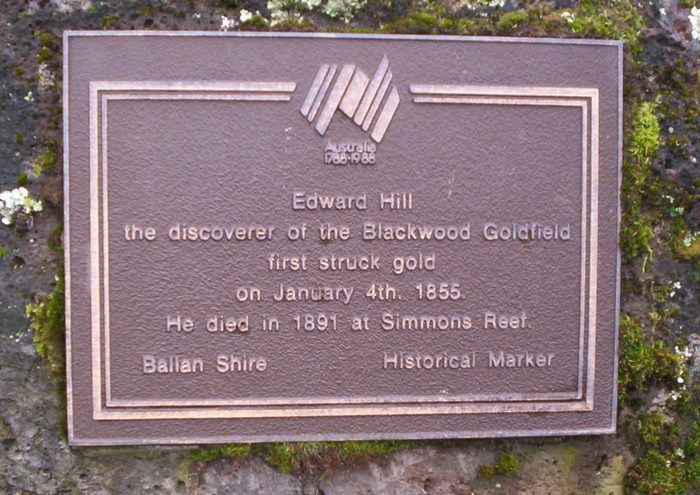
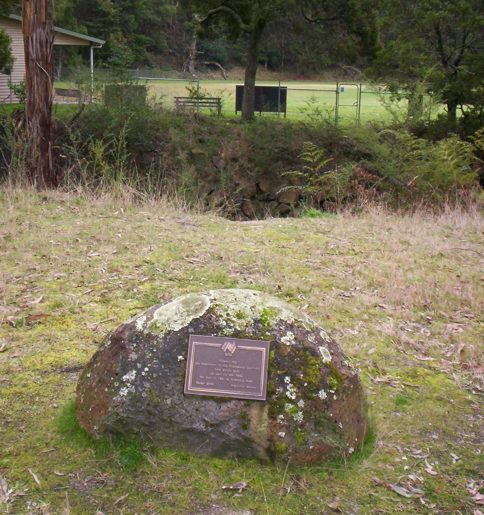
On March 12th, 1891, the Bacchus Marsh Express reported the death at Simmons Reef of Mr. E. Hill, the oldest man and pioneer on Blackwood, who died at Simmons Reef on the 12th March 1891 aged 78 years and was buried in the Blackwood cemetery. He was the discoverer of the Mount Blackwood Goldfield, who subsequently successfully claimed a three hundred pound reward for its discovery.
A goodly number of people were said to have followed his remains to their last resting place. Mr. Dredge, the Wesleyan minister, conducted the funeral service and gave a lengthy and stirring address on the life of the pioneer.
On obtaining a copy of Hill’s death certificate, a curious discovery was found, in that Edward Hill’s name was in fact John Hill, and he is buried under that name in the Blackwood cemetery. He was listed as aged 78 years of Simmons Reef and a builder. He died of Apoplexy and Paralysis. His children were listed as James deceased, Sarah 53 years, Helena 52 years, John 50 years, Edward 47 years, Joshua 44 years, Joseph 41 years, and by second wife Samuel aged 38.
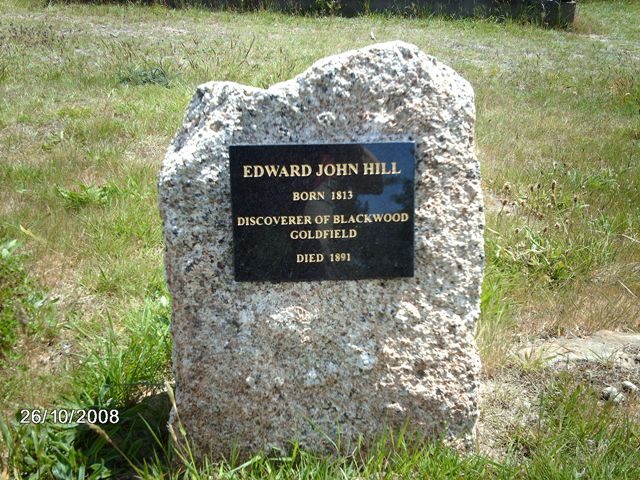
Edward John Hill is buried in the Blackwood cemetery and a headstone records him as such. Buried 1891, with him is his wife Hannah Hill, nee Thornton, buried 14th May 1887. The monument was erected in the Blackwood cemetery by his descendant, Philip Skinner.
A Walk in the Blackwood Bush, 1935
From the Melton Express, Saturday 23rd February 1935. Excursion to Blackwood, by J.L.
The second excursion of the Field Naturalists’ Club of Victoria to Blackwood attracted 14 members of the Club under the leadership of Dr. J. Hegam, and so pleased were they with the result that it was decided to make the excursion an annual one. The weather conditions were ideal. The party arrived at midday on Saturday, and the afternoon was spent in a trip to the top of Blue Mount, which is distant about three miles to the north of Blackwood.
A tower stands on the top of the Mount and an officer of the Forestry Department camps at the spot. He is constantly on the watch for outbreaks of fire and is fully equipped to deal with any emergency. Along the gullies leading to the top, bird-life was fairly plentiful. Parrots were numerous; the Crimson-crowned Lorikeet is now wearing its brightest plumage.
Crossing the river about two miles west of the township of Blackwood, we pass by the first white man’s grave dug in the district 80 years ago. It is placed on a stony bank, facing the east, a hundred yards or so from the river where Messmate and Stringy bark trees grow 80 feet or more in height. The place is known as Dead Man’s Hill. The grave is neatly outlined with stones of an even size and a cross of white stones on top.
Melton Express, 1935
The Death Certificate & Administration
Margot Hitchcock researched the following:
On trying to find more about who Isaac Povey was, she obtained the administration papers, as there was no will for Isaac Povey. The documents stated that Isaac Povey was a bricklayer of Mt. Blackwood, and his property did not exceed seventy pounds, and that his brothers in England were Charles Povey and Joseph Povey. His cousin, Joseph Webb, was the only surviving relative in the Colony of Victoria.
Joseph Webb, late of Mt. Blackwood, signed the document at the Supreme Court in the Colony of Victoria, saying he was the cousin of Isaac Povey and the only surviving relative in the Colony of Victoria, and was entitled to such letters of administration and the goods and chattels of Isaac Povey. Joseph Webb stated he was now residing in Melbourne and was a miner. Signed the 19th day of December 1855.
On obtaining Isaac Povey’s death certificate it stated his parents’ names were unknown. His name was recorded as Isaah Povey, parents unknown. He was aged 21 years, making him born in 1834. It was stated he had died at Mt. Blackwood. The death was registered by Dr. Caesar Kieser of Mt. Blackwood. He died of pulmonary disease of the lungs, and died on the 10th July 1855.
Today the grave stands alone, occasionally visited by people who search it out. The area surrounding the grave is riddled with mine shafts and open reefs with quartz exposed, where local legend has it that gold was found while they dug his grave, presumably on his claim. The bridge across the river having been washed away, access is only by a rough track across the river, and up the steep hill through the bush and natural surroundings now reverted to much the same as when Isaac Povey first arrived there. A fitting resting place for a pioneer.
So to end this story, we now have an interesting tale to tell of an unknown young man who lost his life in 1855 in the early days of the Blackwood Goldfields.